
C31 · Ferrous Metallurgy
Stainless Steel Plates for the Steel Rolling and Forging Industry: 310S/304 Selection and 6 Part Lists
In steel rolling and forging industry, we have organized six parts that use stainless steel: commonly used 310S / 304 / 904L, with thickness ranging from 3–275 mm.
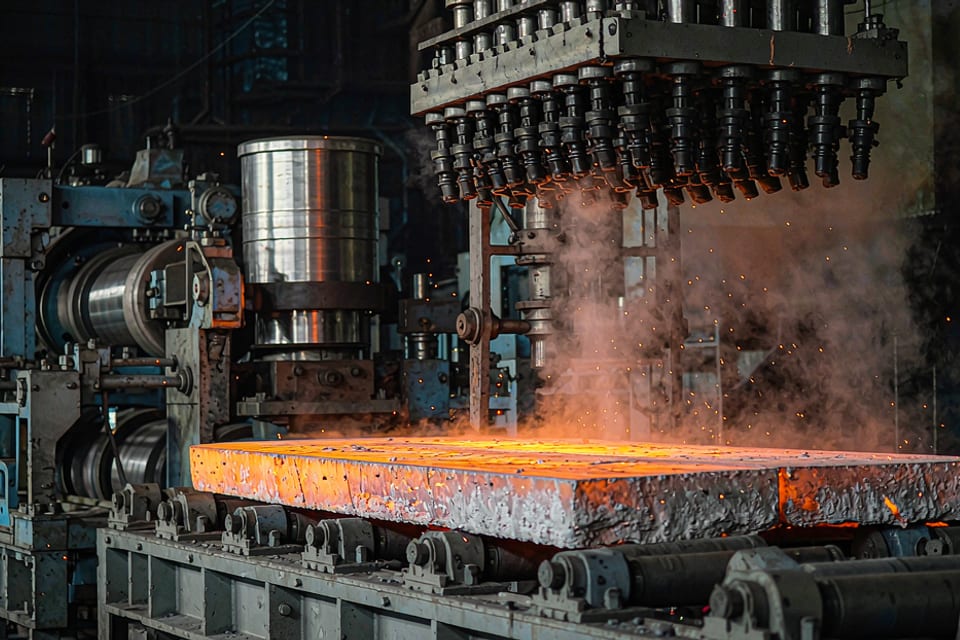
6 parts and selection list
| Part / Component | Recommended grade | Specification / Thickness | Surface | Main Failure Modes | Reference Standards |
|---|---|---|---|---|---|
| Casting Foot Rollers | 1Cr13 High Ni Stainless Steel Overlay/Ni Base Overlay; Base Material 42CrMo | Roll Diameter φ100–275mm | Overlay/Finished Surface | Thermal Fatigue (Surface and Internal Temperature Difference of About 300°C → Networked Thermal Cracks) + Acidic Corrosion (Protective Slag + Cooling Water) + Wear; Support Welding Position/Screw Holes Deformed after 3 Times of Casting | Overlay/GB/T 984/NB/T 47014; Roll Body/JB/T 5000 |
| Rolls for Strip Guide/Blades | Heat Resistant Stainless Steel/Overlay/304 | 20–100mm | Overlay/Finished Surface | High Temperature Oxidation + Slab Scrubbing + Thermal Fatigue | According to Equipment Drawings; GB/T 984 |
| Radiant Tubes in Heat Treatment Furnaces | 310S/314/Thermal Castings | Roll Wall Thickness 8–30mm | Casting/Forging | Creep/Oxidation/Heat Cycle Cracking | GB/T 8492;GB/T 3280 |
| Pickling tanks (Hydrochloric/Sulfuric/Mixed acid) | 904L/254SMO/310S | Wall Thickness 3-12mm | 2B/Acid washed | Composite | ASTM A240;NB/T 47002 |
| Acid regeneration roaster/piping | 310S/904L/254SMO | 3–20mm | 2B/Acid washed | High temperature 600–800℃+HCl/HF+FeCl₂ | ASTM A240;GB/T 3280 |
| Molten metal hoists/grippers/Slag pots | 304/316LHeat-resistant castings | 10–50mm | 2B/For industrial casting | High load+thermal fatigue+oxidation | GB/T 3280;GB/T 8492 |
Table isStandard configuration.Same part may use different grades (304, 316L, or 2205) depending on media, temperature, and welding method—explain the conditions clearly rather than specifying a grade.
Material Selection Tips
- Most common grades in this industry are 310S (3), 304 (2), and 904L (2) —— numbers in parentheses indicate the number of parts involved, useful for quoting and material procurement.
- High-temperature section also accumulates thermal fatigue and oxidation. Use 310S / heat-resistant castings (6/6 hits).
- Corrosion from chloride ions and salts is the most common source (pitting, crevice corrosion) (2/6 hits).
- Minimum thickness 3–275 mm: Thin plates are mostly formed parts (considering bend back-arc and deep drawing cracking), thick plates are mostly welded structures (considering heat input and sensitization).
Common Questions
Which stainless steel is used most in the black metal smelting and rolling industry?
Out of the total 6 categories, 310S appears most frequently (3 times), followed by 304 (2 times) and 904L (2 times). Specific to a part still depends on the medium and temperature, for example, stainless steel countertops that come into contact with salt water should switch from 304 to 316L.
What parts are most prone to failure?
Typical issue: "Continuous Casting Foot Roll": Thermal fatigue (surface-to-core temperature difference around 300°C → networked thermal cracks) + Acid corrosion (protective slag + cooling water) + Wear; weld joints and pin holes deform after three casting cycles. Recommended grade 1Cr13 high Ni stainless steel overlay/Ni-based overlay; base material 42CrMo, size roll diameter φ100–275mm.
What thickness should I choose?
Thickness range in the list is 3–275 mm. Thin plates consider forming and surface quality, thick plates consider welding and structural strength; different manufacturers may have varying values for the same part based on your drawings or conditions. Recheck according to your specifications.
Related Materials and Adjacent Industries
Applications6