
S2 · Duplex Flange & Desalination
Double Phase Steel Flanges for Desalination (List of Media, Grades, and Conditions)
List the media, grades, and boundary conditions related to desalination applications: 5 typical components/processes, including recommended grades, specifications, failure reasons, and standards.
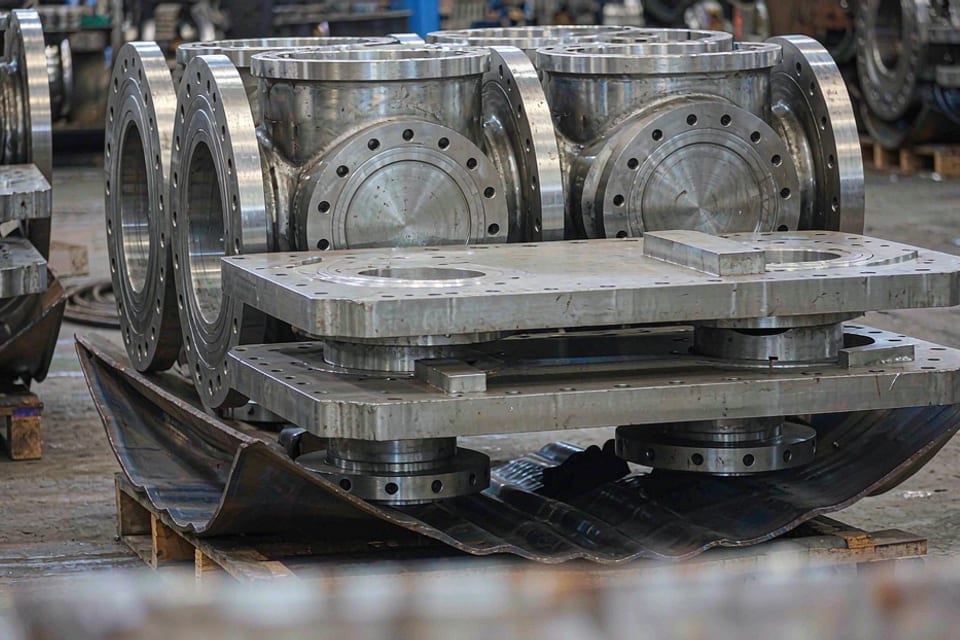
Five Parts and Material List
| Part / Component | Recommended Grade | Specification / Thickness | Surface | Main Failure Modes | Reference Standards |
|---|---|---|---|---|---|
| Double-Phase Steel Welded/Threaded Flanges | 2205(F51/S31803)/2507(F53/S32750)/Zeron 100(F55/S32760) | Class 150–2500;DN15–DN1500 | 2507 PREN 41–43;2205 PREN 34–36 | Yield Strength of 2507 is approximately twice that of 316L, allowing for thinner wall under the same pressure; long-term service above 250℃ requires evaluation of σ phase | ASTM A182;ASME B16.5;NACE MR0175/ISO 15156 |
| RO High Pressure Sea Water Feed Pipes/Concentrate Pipes | 2507 Seamless or Welded Tubes | Operating Pressure: 5.5–7.0MPa ; Design PN100 ; Outer Diameter Φ6–530mm | Minimum Yield Strength of 2507 is 550MPa; CPT > 50℃ ; Continuous abrasion resistance up to 6m/s | Erosion/Corrosion on 316L in SWRO High-Pressure Section Within Months;, Reduce Wall Thickness of 2507 by Over 30%. | ASTM A789/ASME SA789;ASTM A240 |
| RO Membrane Shell/Pump Impellers/Energy Recovery Devices | 2507 Forgings/Castings/2205 | High-Pressure Pump Casing, High-Pressure Pump Blades, High-Pressure Pump Shrouds, Energy Recovery | 2507 forged parts tensile strength ≥ 800MPa, yield strength ≥ 550MPa, impact toughness at -40℃ ≥ 100J | 2507 forged parts lifespan is more than three times that of 316L castings; casting defects are a major risk for high-pressure pumps | ASTM A182 F53;ASTM A995 |
| MSF/MED heat exchanger tubes/tubing/headers | 2507 tube/plate | MSF Saltwater reaches 110℃, MED Shell side 60–70℃ | Concentrated Salt Water Cl⁻ 60,000–80,000 ppm | 2507 SCC resistance in MSF brine is far superior to 304L/316L; lower cost than 6Mo and titanium | ASTM A789/A815;ASTM A240 |
| Flanges and fittings for seawater desalination | 2507/2205 | Class 150–2500;RF/RTJ | By project NACE applicability | Same material as pipe, avoid galvanic corrosion; seal face roughness per MSS SP-6 | ASTM A182;MSS SP-6;NACE MR0175 |
Here areStandard configurationSelect Materials
Common Alloy Numbers: 2507 (5), 2205 (3) —— Number of affected areas in parentheses, useful for quoting and material preparation.
- Welding Considerations
- Watch out for sensitization and chloride ion stress corrosion cracking (SCC).
- Thickness Range: 5.5–2500 mm —— Thin plates are often formed parts (consider bending rebound and deep drawing cracks), thick plates are mostly welded structures (consider heat input and sensitization).
Common Issues
Which stainless steel is used most for double-phase flanges in seawater desalination?, Based on the top 5 areas, 2507 (3) and 2205 (2) appear most frequently., Specific to a part depends on the medium and temperature, e.g., stainless countertops that contact salt water should switch from 304 to 316L.
Stat by total pages, the top 5 parts are 2507 (3 items) and 2205 (2 items). For specific parts, check media and temperature, for example, stainless countertops need to switch from 304 to 316L when exposed to saltwater.
What parts are most prone to issues?
By failure description, typical is "duplex steel weld/threads flanges": yield strength of 2507 is twice that of 316L at the same pressure; wall thickness can be reduced for equivalent pressure. Long-term service above 250°C requires evaluation of σ phase; recommended grades 2205 (F51/S31803), 2507 (F53/S32750), Zeron 100 (F55/S32760); pressure classes Class 150–2500; pipe sizes DN15–DN1500. For this type of condition, specify medium concentration, temperature, and cleaning method on the drawings.
How thick should the material be?
Thickness ranges in the list are 5.5–2500 mm. Thin plates consider forming and surface quality, while thick plates look at welding and structural strength; different manufacturers may have varying values for the same part, so review your drawing or conditions to confirm.
Related materials and adjacent industries
2205Material specificationsStainless fasteners: A2-70/A4-70/A4-80/D series and latest standardsStainless FastenersSanitary diaphragm valves/clean valves: ASME BPE, Ra, temperature boundariesSanitary ValvesPeroxide sensitization and chloride ion stress corrosion cracking: Temperature-time-concentration boundariesSensitization & Chloride SCC